
How can scientists and engineers systematically consider the societal consequences of their research at its early stages without adding another costly layer of assessment?
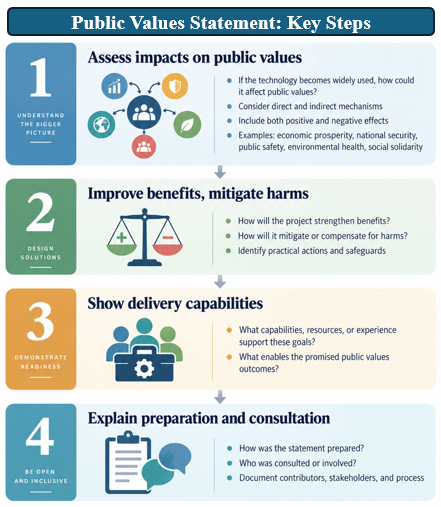
In our new article, “Proposing a ‘public values statement’ for aligning applied research with societal needs and values,” John P. Nelson, Olajide E. Olugbade, Justin B. Biddle and Philip Shapira propose a practical approach: the public values statement.
Calls for researchers to consider the societal implications of science and technology have become increasingly common. Yet translating principles of responsible research and innovation into everyday research practice remains challenging. Existing requirements, such as broader impacts statements, can be wide-ranging and may not provide researchers with sufficient structure for thinking through the specific consequences of their work.
The public values statement is designed as a scalable and relatively low-cost mechanism that could be incorporated into research funding, support, or research-facility applications. It prompts researchers to consider plausible positive and negative consequences of their work across dimensions including economic and social impacts, environmental sustainability, national security, and other public values.
We piloted the approach in a workshop with researchers in manufacturing and materials science. The pilot showed that a structured public values statement can help researchers identify a diverse range of potential societal consequences associated with their research. It also highlighted the need for further support to help researchers move from identifying possible impacts to developing actions that can amplify positive outcomes and anticipate or mitigate negative ones.
The broader aim is to make attention to public values a more routine part of how applied research is conceived, supported, and undertaken, embedding responsible innovation into the everyday practices of research.
Nelson, J.P., Olugbade, O.E., Biddle, J.B. & Shapira, P. (2026), “Proposing a ‘public values statement’ for aligning applied research with societal needs and values.” Journal of Responsible Innovation, 13(1). https://doi.org/10.1080/23299460.2026.2700819
This paper is Open Access (free to download)
For other blogs and papers on anticipation and responsible research and innovation themes, see
- A Quick Sustainability Assessment Tool for Responsible Innovation (2026)
- How can we foster responsible innovation in synthetic genomics? (2025)
- Innovation intermediaries at the convergence of digital technologies, sustainability, and governance: A case study of AI-enabled engineering biology (2023)
- Collaborating constructively for sustainable biotechnology (2019)
- The dilemma of societal alignment (2019)


