
New technology projects often need a fast and inexpensive way to identify possible sustainability impacts at an early stage. However, existing assessment methods usually require a lot of data, focus on only part of the picture, and are often used too late to influence important design and process decisions. As a result, there is a need for practical tools that can help researchers and innovators consider sustainability from the very beginning of a project through to commercialization.
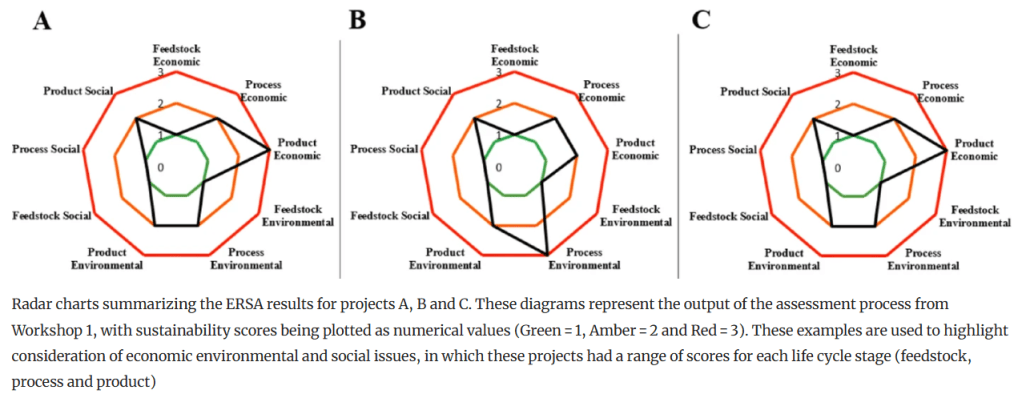
This paper* introduces a new tool: Early Rapid Sustainability Assessment (ERSA). ERSA provides a quick way to examine the potential environmental, social, and economic impacts of technology transfer projects. The tool is based on the principles of Responsible Research and Innovation (RRI) and encourages discussion around four key ideas: anticipation (thinking ahead), inclusion (involving different perspectives), reflexivity (reflecting on assumptions and impacts), and responsiveness (adapting when needed).
The tool was tested in workshops involving engineering biology researchers from three UK research institutes and two small businesses. The results showed that ERSA works well alongside existing assessment methods by bringing together knowledge from both natural and social scientists. It helps researchers identify sustainability opportunities and challenges while recognizing the uncertainties that are common in early-stage projects.
ERSA produces easy-to-understand results that highlight a project’s sustainability strengths, weaknesses, trade-offs, and areas where more information is needed. The tool can be used as a first step before more detailed assessments and can help guide research, innovation, and technology transfer decisions. Overall, ERSA offers a practical way to address sustainability issues early in the innovation process, even when information is limited and future impacts are uncertain.
* Adam McCarthy, Claire Holland, & Philip Shapira (2026). Developing an early rapid sustainability assessment tool for responsible innovation. Journal of Technology Transfer. https://doi.org/10.1007/s10961-026-10352-9
This paper is Open Access.


1 Comment
Comments are closed.