
Artificial intelligence (AI) is changing how scientists work, but does it actually help create better science?
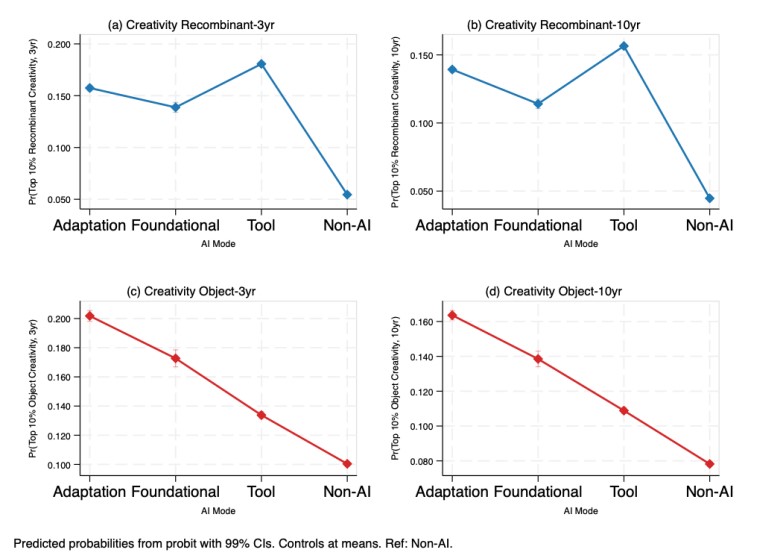
In a new study, available as an arXiv preprint* (not yet peer reviewed), Liangping Ding, Cornelia Lawson, and Philip Shapira analyze more than one million scientific publications to examine how the use of AI relates to scientific creativity. They look at different aspects of creativity, including how often research combines ideas in new ways, introduces new concepts, and achieves scientific impact through citations.
The findings show that publications involving AI are significantly more likely to be among the most creative scientific papers. Compared with non-AI research, AI-related papers are 5.5 to 10.2 percentage points more likely to rank in the top 10% for creativity.
However, the study also found that not all AI research contributes to science in the same way. Different approaches to using AI support different kinds of creativity.
Tool-oriented AI research, which applies existing AI models to domain tasks in science, is associated with the largest gains in recombinant-based creativity (new combinations of existing ideas and knowledge). Adaptation-oriented AI research, modifying AI models for domain-specific scientific problems, is associated with relatively higher object-based creativity (new concepts, methods, or objects of study).
These results suggest that AI advances science through multiple pathways rather than a single mechanism. The way researchers use AI matters.
The study contributes to ongoing discussions about AI’s role in research and innovation. It also highlights the need for research evaluation and science policy frameworks that recognize different forms of creativity and different ways that AI can contribute to scientific progress.
* Liangping Ding, Cornelia Lawson, and Philip Shapira (2026), Does Artificial Intelligence Advance Science?, arXiv. https://doi.org/10.48550/arXiv.2606.05118.
This arXiv preprint is Open Access.


