
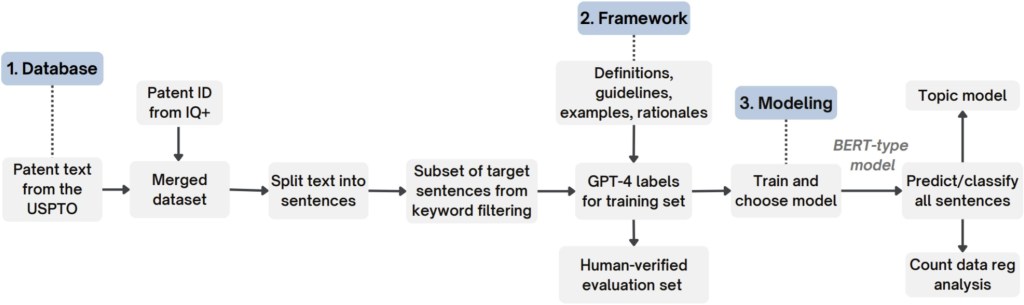
In a new paper, co-authored with Sergio Pelaez, Barbara Esteves-Ribeiro and Gaurav Verma, we develop a method for identifying societal value embedded in patent documents. Applying this approach to more than 154,000 AI patents filed with the US Patent and Trademark Office, we find that patents describing their potential benefits for society tend to score higher on several established measures of patent value.
In other words, inventions that explain how they could help solve real-world problems appear to enjoy greater technological significance and commercial potential.
More than technical language
Patents are often seen as highly technical legal documents. Yet they also tell a story about the inventors’ intentions and why an invention matters.
In our paper, we introduce the concept of Public Value Expressions (PVEs) – statements that describe the societal problems an invention addresses or the public benefits it could deliver. These might include improving medical diagnosis, reducing energy use, making workplaces safer or increasing accessibility for disabled people.
These descriptions go beyond explaining how an invention works. They explain why it deserves attention.
Using large language models, we analyzed the text of AI patent documents to identify Public Value Expressions. We also interviewed patent attorneys, inventors, patent examiners and a linguist to better understand how these narratives are developed and used in practice.
A clear pattern
The results were striking.
Patents containing more references to societal benefits were consistently associated with stronger indicators of value. They were cited more frequently by later patents, tended to have broader international protection, contained more claims and covered a wider range of technology classes.
These are widely recognised indicators that a patent is both technologically significant and commercially important.
Importantly, we controlled for factors such as industry, filing year and patent owner, making it less likely that the relationship is simply a coincidence.
The rise of “societal value embedding”
Why would references to public benefit be linked to more valuable patents?
We suggest that inventors and patent lawyers increasingly engage in what can be termed societal value embedding. Rather than presenting an invention solely as a technical advance, they deliberately frame it as a solution to wider social challenges.
We argue that this serves two purposes. First, it reflects changing expectations. Governments, investors and the public increasingly expect emerging technologies, particularly AI, to demonstrate positive social impact.
Second, these narratives may strengthen the patent itself. Demonstrating how an invention addresses meaningful problems can help reinforce arguments about its usefulness, novelty and broader significance during the patent examination process.
In other words, talking about the public good may also be good patent strategy.
A paradox at the heart of innovation
The study reveals an underlying paradox. Claims about helping society become embedded in legal documents whose primary purpose is to secure private intellectual property rights.
This does not mean that inventors are being disingenuous. Many AI technologies have the potential to deliver social benefits. But it does suggest that narratives about public value are becoming an important asset in their own right.
The promise of social impact is no longer simply something communicated through marketing or corporate responsibility reports. It is increasingly embedded in the legal foundations of innovation itself.
Why this matters
As governments around the world invest heavily in AI while simultaneously demanding responsible innovation, the way inventors describe their technologies may become increasingly important.
If societal benefits help strengthen patents, then the language used to frame technological innovation deserves closer scrutiny. Are these claims genuine reflections of an invention’s potential, or have they become another strategic tool in the competition for intellectual property?
The answer is likely to be somewhere in between.
What this research demonstrates is that innovation is never just about technology. It is also about the narrative and the intent. How an invention is framed – particularly in terms of its societal benefits – is a valuable and important feature of an invention and one that should be carefully assessed.
Citation: Sergio Pelaez, Barbara Esteves-Ribeiro, Gaurav Verma, and Philip Shapira. Do societal promises influence patent value? An analysis of inventions in artificial intelligence. Research Policy, 55, 8, 2026,
Open Access: This paper is available at: https://doi.org/10.1016/j.respol.2026.105566


