
The latest (November 2025) preprint from our AI in the Lab project at the Manchester Institute Of Innovation Research.
“Tracking AI’s Scientific Anatomy: A Novel Framework For Analyzing The Use And Diffusion Of AI In Science” — by Liangping Ding, Cornelia Lawson, and Philip Shapira — develops a framework to identify AI’s role in scientific papers, differentiating between Foundational, Adaptation, Tool and Discussion modes of AI research.
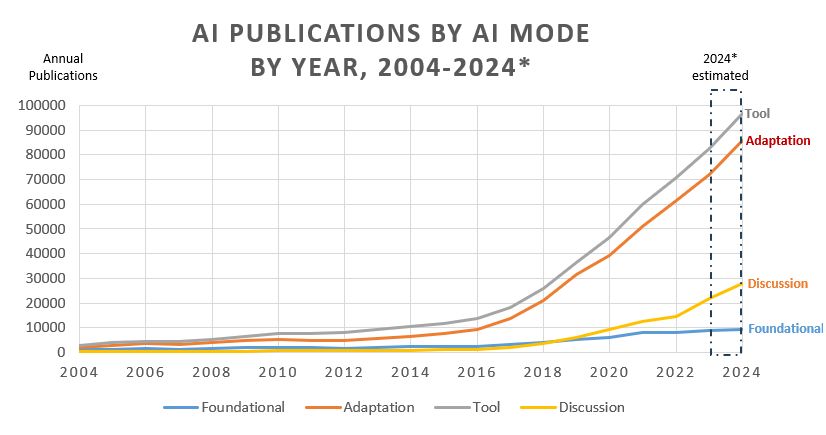
These modes reflect the different ways that AI being used or referred to in scientific papers.
Here are short definitions of the four AI research modes:
Foundational: contribute to technical progress of AI itself – new architectures, algorithms, or optimization strategies.
Adaptation: refines or extends AI models – adapt techniques to specific research requirements.
Tool: uses existing AI technologies without architectural change – translates AI methods into other scientific fields
Discussion: provides theoretical insights, reviews, or commentaries without directly implementing AI models.
We identify AI and non-AI papers, in OpenAlex, 2004-2024. Then we use a two-stage GPT4o-SciBERT pipeline, with human validation, to categorize AI publications by their focus on four modes.
This allows us to capture AI’s diverse contributions, from theoretical advances to practical applications and critical analysis. We examine AI’s trajectory across these modes by analyzing time series, field-specific, and country trends.
We find a rapid growth in AI tool and adaptation papers in scientific publications, as AI is deployed across all scientific fields. Discussion papers about AI have also grown noticeably in recent years.
Our approach expands on search-term based identification of AI contributions and offers insights into how AI is being deployed in science.
The preprint is available (open access) on SocArxiv at SocArxiv. https://doi.org/10.31235/osf.io/7ed2b_v1
Note. The figure in this post is an elaboration of the work presented in the preprint. It shows overall worldwide trends, drawing on our analysis of OpenAlex publications (N of AI records, 2004-2024* = 1,075,782). *2024 is estimated by exponential regression over prior 3 years as 2024 records are not complete in our May 2025 OpenAlex snapshot.

 Philip Shapira