
Innovation intermediaries at the convergence of digital technologies, sustainability, and governance: A case study of AI-enabled engineering biology
In scaling-up emerging technologies, innovation intermediaries – including incubators, innovation accelerators, research parks, and technology transfer and innovation centers – can perform key roles in facilitating research translation, promoting knowledge and resource sharing, supporting technology transfer and diffusion, and developing innovation capabilities and ecosystems
This paper explores the role of innovation intermediaries in the convergence of digital technologies, with a focus on AI-enabled engineering biology. We examine how these intermediaries address societal and sustainability concerns while pursuing economic goals. Interviews with stakeholders shed light on their approach to responsible innovation in this domain. Despite available frameworks that address societal and sustainability concerns, intermediaries primarily prioritize scale-up and commercialization. This research provides insights for intermediary development, research management, and policy.
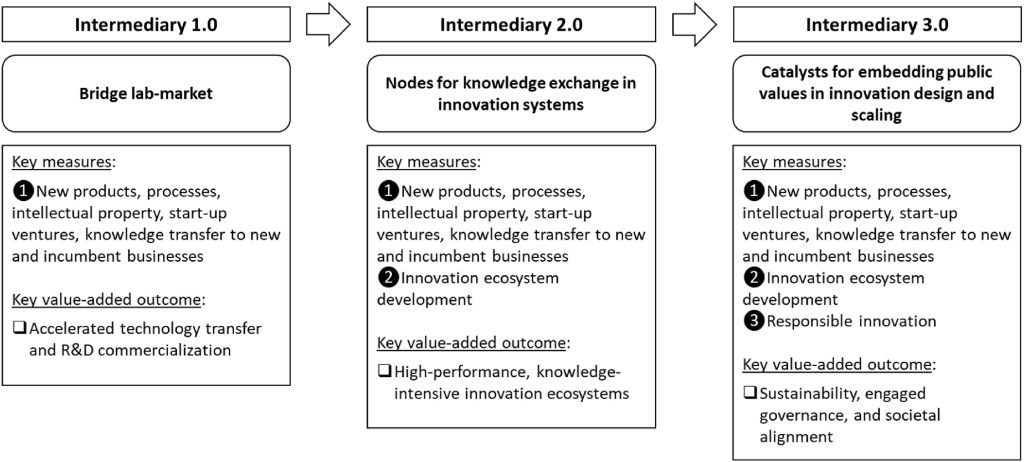
In this paper, we propose a framework that outlines how innovation intermediaries can evolve their missions. We denote the traditional positioning of intermediaries as “Intermediary 1.0“. Here, intermediaries help bridge the gap between research in the laboratory and the development of marketable products, reducing risks along the way. This is often referred to as bridging the “Valley of Death”.
In recent times, we have observed a transition as traditional intermediaries add facilitating functions to connect organizations and foster diverse innovation networks. In this approach, which we call “Intermediary 2.0,” intermediaries focus on serving as nodes in the creation of knowledge-rich ecosystems that accelerate the translation of innovations into the market and driving regional economic growth.
Looking forward, we envisage that innovation intermediaries can play crucial roles in fostering sustainable and responsible innovation. They can do this by adopting new roles and responsibilities that focus on addressing societal challenges and the societal impacts of emerging technologies. We call this stage “Intermediary 3.0,” building on the two previous phases of intermediation to make innovation more sustainable, responsible, and socially relevant.
The framework below synthesizes the pathways and roles conceptualized in the evolution of innovation intermediaries.
For detailed discussion, the application of our framework to AI-enabled engineering biology, and implications, see the full paper, which is available open access.
Claire Holland, Adam McCarthy, Priscila Ferri, and Philip Shapira (2024). Innovation intermediaries at the convergence of digital technologies, sustainability, and governance: A case study of AI-enabled engineering biology. Technovation, 129, 102875, https://doi.org/10.1016/j.technovation.2023.102875.

 Philip Shapira